
an ineluctable life
Mouawad, Gentileschi, Cahn, and Luke 1.

Content warning: sexual violence and suicide.
Early in the six-hour play I saw with my girlfriend this month, an artist in Montreal unveils a life-size tryptic made of human blood, semen, bones, and ash on wood, titled Life of the Virgin. The play, Racine carrée du verbe être (Square Root of the Verb to Be), is about five possible lives the avatar of its auteur (Wajdi Mouawad) might have lived depending on where and whether he had emigrated from Lebanon when he was a child, which is to say that it is about all the possible lives any of us might have lived depending on anything. In the life at hand, he is Talyani the frustrated painter, infuriated by the asinine questions of six confused journalists intent on misunderstanding his work. “I am fascinated by the idea of an ineluctable life,” he finally explains.
Without the civil war, my parents would never have left Lebanon, and I would not have become a painter. What would I have become if I had stayed in Lebanon? Every exile, every adopted child asks themself this sort of question. Not the Virgin. No matter the events, the Virgin would not have had a different life. There would have been the Annunciation, she would have been impregnated by the Holy Spirit, she would have given birth to Christ, and the blood of history would have flowed. Even if the universe had been fragmented into an infinity of universes, in each of these universes, the Virgin would have been the Virgin. These are the Scriptures, even when nothing remains of them but ash.1
For Talyani, the Virgin Mary is a paradigm of destiny. The virgin birth, as rendered by the doubtful exile, signifies against the panic and regret of human choice. If Mary would be Mary in every possible iteration of our universe, that is, if her life is “ineluctable,” or “unable to be resisted or avoided; inescapable,”2 it offers the relief—or is it the burden?—of divine constraint.
So why, then, does the scene of the Annunciation conclude with Mary’s reply?
30. And the angel said unto her, Fear not, Mary: for thou hast found favour with God.
This is Luke 1 from the King James Version.
31. And, behold, thou shalt conceive in thy womb, and bring forth a son, and shalt call his name JESUS.
[…]
34. Then said Mary unto the angel, How shall this be, seeing I know not a man?
35. And the angel answered and said unto her, The Holy Ghost shall come upon thee, and the power of the Highest shall overshadow thee: and therefore also that holy thing which shall be born of thee shall be called the Son of God.
[…]
38. And Mary said, Behold the handmaid of the Lord; be it unto me according to thy word. And the angel departed from her.
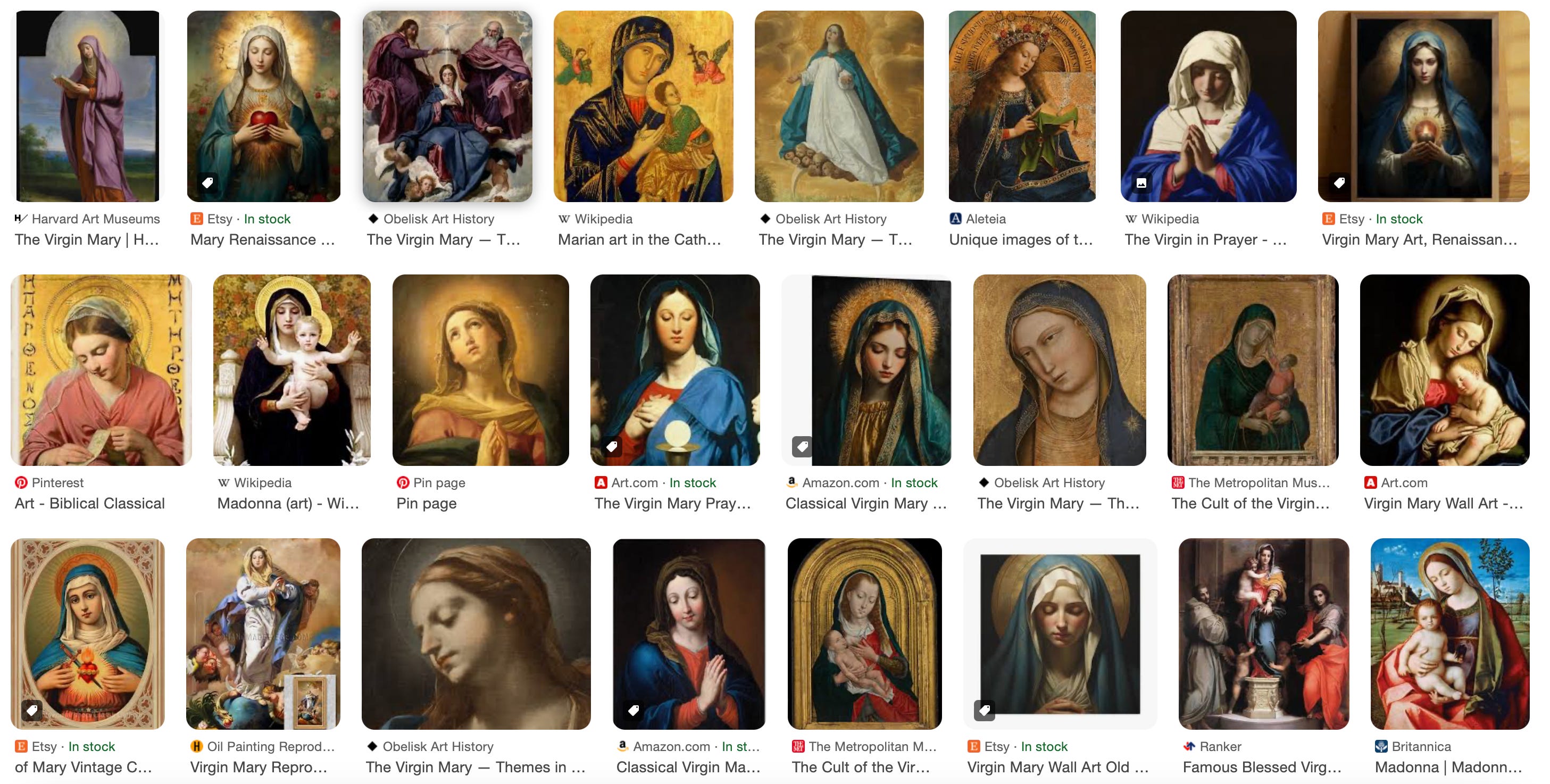
What use answering the angel Gabriel in the face of his announcement if to bear the Son of God has been decided from on high to be her destiny? Why proclaim herself a “handmaid”—a servant—“of the Lord”? What use her words, reiterating God’s, “be it unto me”? In his Homilies in Praise of the Blessed Virgin Mary, the twelfth-century French abbot Saint Bernard de Clairvaux frames Mary’s word as the crux of the Annunciation and the Salvation it entails; it is her consent to the birth, and not God’s willing it, on which the incarnation of Christ depends. The abbot addresses her:
He [the angel Gabriel] waits for your response: it is time for him to return to he who sent him. We, too, wait, oh Our Lady. Miserably burdened by a sentence of condemnation, we await a word of pity. Now here it is, it is offered you, the ransom of our salvation. Consent, and we will be immediately free. In the eternal Word of God, we were all created; alas, death does its work in us. A brief response from you suffices to recreate us, so that we will be called back to life. Your reply, oh sweet Virgin … the entire world waits for it, prostrated at your knees. And not without reason, for on your word depends the solace of the unfortunate, the return of captives, the deliverance of the condemned, the final salvation of all the sons of Adam, of the entire race. Do not delay any longer, Virgin Mary. Quickly, respond to the angel, or rather, by the angel respond to the Lord. Reply with a word and welcome the Word; pronounce yours and conceive that of God; proffer a temporary word and embrace the eternal Word. Why delay? Why tremble? … Happy Virgin, open your heart to faith, your lips to assent, your breast to the Creator. … Rise, run, open to him: rise by faith, run by willingness to his will, open to him by your consent. Behold, she said, the handmaid of the Lord; be it unto me according to thy word.3
Note the tension, here, between instruction and beseeching, between the imperative tense and the desperation of request. Across the language of commandment shoots the exigency of “faith,” “willingness,” “consent,” which Mary must manifest to meet the pressure of not only the will of God but the desires of all humankind. She must consent to be commanded, relinquish herself to a destiny already chosen, to be a “handmaid,” willingly. Why must Mary align her will with that of God? Why must her word “welcome,” “conceive,” and “embrace” His?
I wonder what would have happened had Mary been silent; as Talyani has it, she would have borne the Christ-child anyway. Can her reply, then, be called consent? Has she not, rather, ceded to what must be, to what will be?


Look at these paintings; real paintings, not paintings in a play. On the left is madonna (bl.arb.) by Miriam Cahn (1997); on the right, Lucretia by Artemisia Gentileschi (1625). In Miriam Cahn’s rendition, a chalk-white Madonna, mother of the Christian faith, clutches her vulva and her breast. See the red blush of contact with her fingers to match her red nose and her red neck and the thick cleft of her red mouth. She’s hairless, ghostly, muscular and voluptuous with hollow, pale, serene blue eyes aimed not up in faith or down in modesty but—somewhere. Three fingers disappear into the red slit between her thighs.
The unusual image of her grip on her own virgin flesh reminded me of the Gentileschi painting of Lucretia, whose canonical rape and suicide was the foundational myth of the Roman republic. In most renditions (by male painters) of Lucretia’s final act, she’s figured as prostrated, limp, dagger held aimlessly, loosely, her pained eyes flung towards a bitter sky. But see Gentileschi’s: Lucretia’s furious brow and her firm grip on the dagger and her breast; blood fills the fingertips that press into the butt of the knife, and her flesh spills over her determined palm. With her eyes she addresses her God, but with her hands, herself.
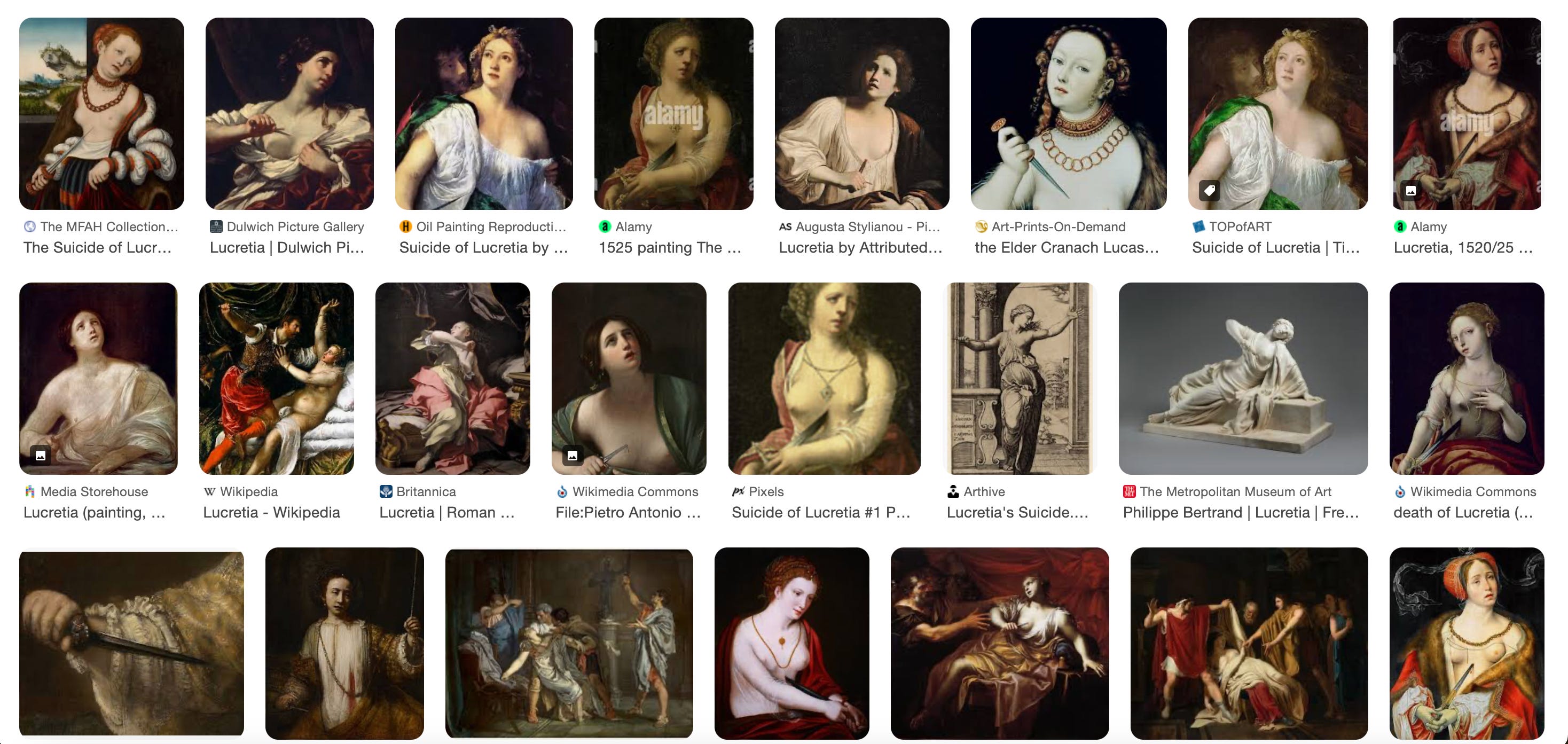
Like Mary’s word of assent to carry Christ, Lucretia’s rape and suicide congeals a paradox of decision in the face of its denial. There is the imposition of a will upon her body against hers and her decision to destroy that body to testify to her unwillingness. To consent to die to give the final word of her non-consent to what had been done to her. As Livy recounts it, Lucretia decrees, before plunging the knife into her breast, “What is due to him is for you to decide. As for me I am innocent of fault, but I will take my punishment. Never shall Lucretia provide a precedent for unchaste women to escape what they deserve.”4 Gentileschi captures, then, Lucretia’s sole possibility of refusal: to destroy herself. And unlike Mary, figure of deliverance, Lucretia’s death denies pardon not only to herself but to generations to come. Rape, that cruel usage of the flesh against the will, she tells us, can have no survivors.
Cahn’s and Gentileschi’s portraits of these women at our mythological origins attest to the contradiction between power and powerlessness, to the drama between the will to act and the limitations on its recourse. On the one hand, they present the acts of Mary and Lucretia as an exercise of the woman’s will on the sole vessel over which she has authority: her very flesh. On the other, they indicate the conditions of impossibility within which these women lived, subjected as they were to wills, divine or male, that foreclosed any alternatives. If Mary’s faith leads her to understand herself as “handmaid” to the will of God, Lucretia’s convictions hold that she must die rather than license “un-chasteness.” Both have their belief about the constraints of their roles and both act, decisively and in contradiction with themselves, to somehow uphold it.
Contrasting the beauty of Mary’s story and the tragedy of Lucretia’s, I can imagine a reading rooted in the logic virtue and vice: that Mary’s concerns the preservation of virginity, and Lucretia’s, its desecration; that the will in the first is holy, and in the second, base. That is why Mary must assent to power’s purpose for her womb, and Lucretia, refuse it. But there is also a reading, I guess what I might call a feminist one, attentive to authority’s operation in both instances via threat: Mary cedes, and lives—Lucretia dies to refuse, or refuses and therefore dies. There is no otherwise.
Return to the triptych’s original paradox between form and content: the virgin birth as uniquely ineluctable because it concerns the divine, and the rendition of its chosen figure out of human substances, our fluids and our structure and our ash—the materials of our birth and of our death. She’s made of us. The human drama: the great will to act on the world and the smallness of our range. What infinite lives might have been, as testament, to what? That we were free.
Wajdi Mouawad, Racine carrée du verbe être (2023), Léméac, translation mine.
Merriam-Webster.
Quoted on a lecture slide for Qu’est-ce que consentir? (What is consent?), a course taught at Sciences Po by Frédéric Gros; translation mine.
Livy, The Early History of Rome (510), Book 1, p. 99.