
femme piquée
on women and the nude.

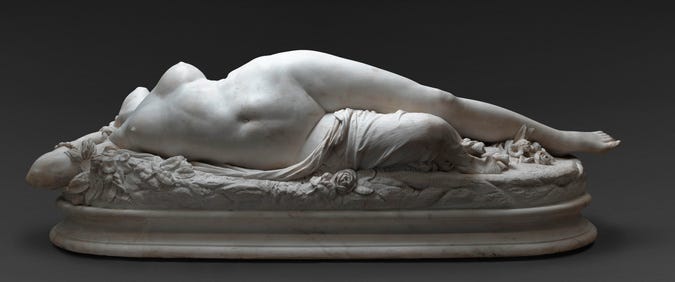
Wednesday afternoon at the Musée d’Orsay. Not far from me, a ring of students sketching a white sculpture of a woman lying twisted on her side. Femme piquée par un serpent. I paced at my post next to the Statue of Liberty, which had seemed to me an apt symbol of the occasion on which I was to meet the boy I was waiting for: his English conversation lesson. I knew that this would be my last time teaching him and he may or may not have known that this would be my last time teaching him depending on whether my boss, his grammar teacher, had met with him already, but it was important that I be indifferent to this. I was to be friendly; I was to act as though nothing had happened; I was to proceed with our lesson as though there were nothing wrong at all until the very last moment, at which point I would hand him back my notecards and say, “Unfortunately.”
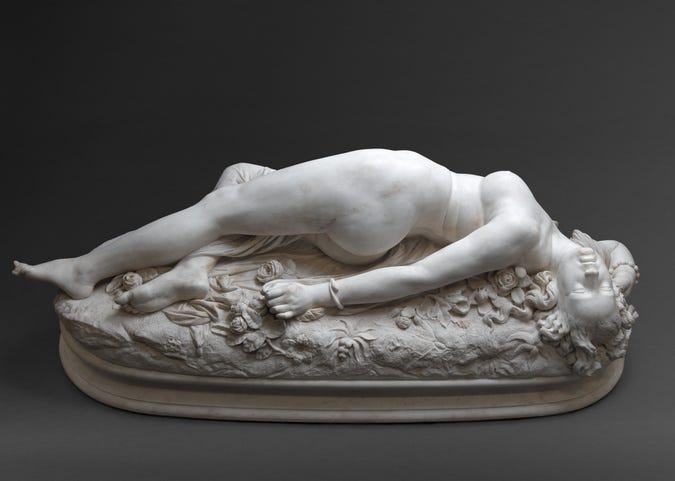
Eyed the students, eyed the woman, whose face I could not see. From my angle it could have been pleasure—the leg’s reach, the fold of the waist, the extended ribcage, the elbow bent, the turned cheek. The serpent, I couldn’t make out for the roses and fabric beneath. I had seen such a woman, such a pose, and this thought excited me, that I knew something men knew. It excited me also because beyond having seen I had been such a woman. I had lain like this, or rather posed like this, and yes it was a pose, even in the thrill of it, and perhaps even a pose in imitation of a statue like this I had seen sometime before. Something I have always found curious, something unrepeatable that nevertheless I will tell you is that what people say—to be kind, to be seductive—when we’re alone together is not that I look like a living and beautiful thing but that I look like art. Femme piquée par un serpent, scandalously made from a cast of a demi-mondaine, Apollonie Sabatier. We are to know this fact, that it was cast and not “created,” the placard reads, from the un-buffed cellulite at the top of her thighs. 1847.
My remembered living gesture recalling it, or something like it. How would I lie on a bed, how stand in a doorway, had I never seen a statue of a nude woman leaning or supine? How arrange my hair around me had I never seen that painting of Ophelia drowned? Femme piquée: imitation of an ending and beginning of a life, fixed now amidst a cloud of young amateur artists across from me, imitation whose shadow I recognized in the unrepeatable moments I had lived, moments in which what I always think of and what my lover sometimes thinks of (when it is not one another) is art. Why this? Last time, there had been a moment—she was tired—I sat up and looked and there it was, the painting by Courbet I’d seen that morning, the painting which had been a private gift no one else was meant to see, the painting long kept behind a little drawstring curtain in the house of a diplomat and yet which I had witnessed myself on a museum wall in a swarm of babbling tourists, the painting living in my mind and now imprinted on this body, this loved body, here. L’Origine du monde. Another time, when I glimpsed a remembered painting I suddenly paused—I adjusted her arm, I asked her to lie and breathe and yes there it was I could see that painting, too, in her, and because it was one of infinite paintings of Venus, La naissance, I felt that what she was was an image our culture had invented to create and then fulfil its own desire, and yet what she was was a person only I, that night, could see, and this connected and distinguished me at once.
There he was, my student, coming down the stairs with his backpack and his black hoodie reading NEW YORK. He gave me a nod as I approached. “Hi!” I said, perhaps too bubbly, but he seemed normal—was it normal?—no, he didn’t know yet, good. He was a man of few words, few English words and few French words, so the pleasantries over the unzipping of the backpack were forgettable. I checked the notebook for his grammar teacher’s lesson log, half expecting expletives in the note section for me, but found it blank. I wrote our names in the notebook and “museum visit” below, then handed it back. Asked for the wad of index cards with the rubber band, withdrew a pen. “Thank you for humoring me and coming here,” I said, and he said it was a nice change from the cafeteria where we usually met, or something like this, and I’m sure I agreed.
This was a student about whom I had doubts. He, like all my students, was pursuing a PhD in math at ENS. My understanding is that the funding for such a thing must be attached to a company. Because his research area, he had told me in our first session, is “image-based drone localization without satellite,” I assume his sponsor is a weapons manufacturer, although I never asked. What I did ask, rather vaguely, was whether “localization” had military targeting applications or mapping ones or perhaps had uses in nature photography, and he seemed puzzled by the question and didn’t respond. I thereafter fit him squarely in the box of unwitting instrument of terror lured into weapons innovation by the sheer force of an abstract interest in numbers, until the following week, when we read Peter and the Wolf. At the end, when the hunters are carrying the wolf, strung upside down to a spit by his ankles, with the happy Peter to the zoo, I said, “What a shame, he won’t be free.” My student said: “They should have shot him; it would have been a funnier ending,” and chuckled at the page, then looked to me. Quickly he could tell, I think, I was troubled by this. I directed our conversation in the thick of his pained silence then towards the United States Endangered Species Act and the legal protection of wolves, and he nodded, smiled, laughed awkwardly.
So this week here we were walking past the femme piqué, past Sappho and Despair, through a room of paintings of peasants and knobby trees, through the room where hung L’Origine du Monde which by our path I had tried to keep from view but which, I gather, he glimpsed in his periphery because I heard the whispered words, the fuck? I pushed forward, past garden portraits and paintings of dignitaries to the back of the rez de chaussée where hung an enormous canvas I thought, I then told him, he’d like. Vue générale de Paris, prise de l’Observatoire, en ballon, from 1855, by Victor Navret. I explained that it had been painted from this angle, from the sky, based not on observation but mathematical calculations.
“How do you think he did that?” I asked. “I figured you might know.”
He scratched his neck. Laughed uncomfortably. He did not know, did not like not knowing. “I didn’t know this was a math lesson,” he said. “It thought I was learning English.”
“You don’t have to know the answer,” I said. “You just need to try to describe your thinking in English. You can make it up, if you want.”
Slowly, he suggested a few things he might have done to calculate the perspective; I wrote down his grammatical mistakes. As we walked away, he said, “That must have taken years.”
“I know,” I said. “So impressive,” half paying attention, glancing between the card against the notebook on my forearm and up at the large painting of cows and their cowherd that would be our next stop.
“That’s kind of sad,” he said. My stomach turned that familiar turn. I looked up at him, asked what he meant.
“It’s just sort of—a—waste of time,” he said. “I can’t see the point. That painter spent all his life learning to make something useless. I understand architecture a little more—like, for example, the Eiffel Tower, because it has—what’s the word?—identity. But—” he went on to say something about architecture making sense because it results in houses, but the art part is secondary to the house part. “But this is just a painting.”
“And we need houses more than we need paintings?”
He nodded. I couldn’t argue with this. But I did. I said something stupid, like, “Well, we don’t really need houses, do we? We could just live in the woods, like other animals do. And since we’ve stopped doing that, and started living in houses, haven’t we always made art?”
“I guess, I just don’t see the point of it. You’re just painting for the sake of painting.”
“I suppose. But do you think everything has to be useful?” An awkward pause. Perhaps he did. An image surfaced, a familiar one: a spiritless undecorated infinite interior designed after the hospital or the limitless hotel, peopled with androids wired with intravenous nutrient tubes and sedated with round-the-clock ambient inner-ear sounds. An image of a dead world. Out of a book—that was it. That is why familiar: it was Ray Bradbury’s or George Orwell’s or Aldous Huxley’s dystopia, in which I had spent so many of my teenage years. These were the novels my mother had handed me, then, to remind me how important it was to read. If we didn’t, they seemed to tell us, we would find ourselves in a universe of horrors, in cities drained of meaning by the useful and the uniform, destroyed by the monopoly of comfort, everything living reduced to the efficient and the entertained. At this, I thought finally to say: “Don’t you ever imagine what the world would be like if it had no art in it?”
“My world doesn’t really have art in it,” he said flatly. “So honestly I don’t have to imagine it.” Already I was feeling frustrated, a little pathetic. “Sure, your life may not have art in it, but you live in a world that has art in it. A world that’s shaped by art.”
“I guess.” I tried a different tack. “Aren’t sports also useless? Is there any point to the game but sheer human excellence?” I knew he enjoyed basketball. The patriarchy argument; a lazy line.
“Yeah,” he said, and looked at me blankly: “I’m not defending it. I just—”
“What about music?” I interjected. “Don’t you like listening to music?”
“Yeah,” he said. In fact, our taste in music, I had learned in our last lesson, significantly differed, but no matter. It was an in.
“Why do you like it?” I pushed. “Doesn’t it make you feel something other things can’t?” I could feel myself resorting to a vapid sentimentalism. What did I want from him? Feeling?
“Not really like that,” he said. “I just do it to fill—I mean, I don’t like—” he faltered. “Silence?” I offered. “The void, I guess.”
I paused. “I get that.” Paused again. I was growing desperate. Could I be so easily cowed? “But,” and I turned back to the enormous painting of the backlit pasture, looked it over again, then up at the burgundy wall behind. “We could be looking at a wall right now. But instead, we’re looking at this.” He couldn’t argue with that. But in deference to the fair, as if unable to hold down the four corners of my reasoning’s tent, I gave him an out: “I guess we could be looking outside.”
An indecipherable laugh. “Yeah, we could.”
The image of the misty quay. (Architecture. Did this prove my point or his?) Beyond this, fields. French fields, like this one. “And . . . ” I continued, stalling, looking at the cows, their gentle faces, the rays of soft light that bathed their backs and the top half of the masterful canvas, struggling, clearly floundering—“everyone in this painting is dead now. The cows, the cowherd. But now, every day, people look at this painting of them in a museum. Now we know what the landscape looked like then.” I eyed the tilled dirt, the shrubs.
“But the painting isn’t the point, then,” he said. “If you want an archive, just make an archive.”
“Sure,” impatient now, “after the invention of photography. But doesn’t it matter that it’s beautiful?”
He made a face, like he didn’t think it was beautiful anyway.
“That’s okay,” I said after a terrible silence. I broke the tension with a strained laugh. “Pastoralism isn’t the most interesting genre,” I said, aware only after I’d said it that the word was probably meaningless to him. “This may have been a little too romantic for you. We can look at a painting that tells a story.”
I walked him into the adjacent room and parked him in front of the enormous August Glaize oil painting, Les femmes gauloises. “Does this make you feel anything?” I asked. It seemed impossible it wouldn’t. But he didn’t at first reply. “What can you see in the women’s faces?”
“Um . . . maybe anger,” he said. “Resentment.”
“Mhm. Do you know the story?”
He shook his head. “It looks like a war,” he said. “And that is the—” he was pointing to the shadowy horse-riding man in a helmet holding an axe above the neck of a woman he had by the hair—“how do you say it?”
“What’s the word for it in French? I may know it.”
“I don’t have it in French, either.”
“An invader?”
“Yes. Invader.” I wrote it down: invader.
“Yes,” I said, “the Romans have invaded Gaul, which is—” but he nodded, he knew this, I dropped off, looked back at the painting, pointed “—and these women, see this one in the center? She has killed her child rather than let him fall into the hands of Rome.”
He seemed a little taken with this, but I don’t know for certain. I was lost looking over the woman’s furious brow and the long hanging fat body of the bleeding yellow child in her hand.
“This painting,” I said, “was commissioned by Napoleon. When he was Emperor. French resistance to past imperial conquest in the context of the modern expansionist mission. It’s part of a nation-building project. Kind of like the Eiffel Tower. Right?”
He smiled a little, like I’d trapped him. “I guess so.”
I pointed to the painting to his right and with me he turned. “This one is also historical,” I said. Le dernier jour de Corinth. “These women,” I said, “will all be raped or killed.”
“You know that?”
I stepped forward and checked the placard to be sure. Felt his eyes on my back. “It just says they’re ‘fearing their fate.’ But I think so. Look at this one,” I said, and the familiar chill ran up my cheeks. “I’ve always been taken with her. Look at her face, and the dead child in her lap.”
“The child is dead?”
“Look at his shoulder,” I said, “and his arm.” I imitated it. “A living child wouldn’t lie like that. And look at her hand”—I cupped my own hand, looked down at it—“how she’s let it fall beneath his head to the stone.”
“Oh, yeah,” he said. “I find it very moving,” I said. We looked together. Then: “It doesn’t look ancient. I don’t think it’s very accurate. It looks—French.”
“It is French, you’re right. What’s telling you that?”
“Their clothes. I don’t think that’s how people would have dressed.”
“How would they have dressed?”
“For example, the jewelry. Wealthy women in ancient Rome would have had more jewelry and poor women would have had no jewelry. It wouldn’t be like this, with just a little bit for everyone.”
“Mm,” I said. “That’s interesting, I never thought of that. You think that’s a French fashion from a later time?”
“Yes,” he said. “But I do understand the point of these a little more.”
“That’s cool,” I said. Progress? Was convincing him even my job?
On the escalator. He asked me what class I had been teaching that morning.
“Teaching? God, I wish,” I laughed. How little expertise did he think it took? “No, I was taking an art history lecture here, downstairs.”
“Oh,” he said. “But you know a lot about art.”
“Not really,” I said. “I just like going to museums. That’s how I prefer to waste my time.”
We were on the landing now and I smiled for myself the cheeky smile he could not see because he was walking behind. I took him to a little balcony overlooking the main room full of sculptures and pointed to the trio of busts by Cordier, the subject of the morning’s lecture. “Do you see those three?” I said. “They’re by a French sculptor who understood himself to be an ethnographer. If you look at other sculptures of Black women, like that one next to it, by Carpeaux—”
“Carpeaux is French also?” I said yes. “Wow, I don’t know anything.”
“No, that’s okay! You don’t need to know this,” I said quickly. “But if you look at that Carpeaux sculpture, there are four women holding up that globe—”
“They’re women?”
“Yes, they’re women. And each one stands for a continent, and the woman who stands for Africa looks like she’s suffering, and she has a chain around her ankle, like she’s enslaved. But the Cordier sculpture, if you go down and see it later, depicts this African woman as beautiful and dignified. On the one hand, he was depicting beauty from different parts of the world than Europe, which I suppose we can say is a good thing in comparison to depictions of people of color as always desperate and subjugated, but on the other hand, that project was situated in the context of racist pseudo-science premised on the superiority of Europeans. So, her beauty is part of an argument for racialized difference, which at that time was a false alibi for racial hierarchy. So, yes, she’s beautiful, but we’re meant to understand her beauty as fundamentally different from European beauty. So the sculptures are very ambivalent.”
“Isn’t there—” and here I looked up at him, and he scratched his neck again, “like, I don’t know a lot about it, but a mathematical way to calculate beauty?”
“Is there?” I asked. “Do we all find the same things beautiful?”
“I don’t know,” he said. His eyes met mine, looked away, met mine. “But, like, I think they say if you calculate—I don’t know much about it—but calculate whether a face is symmetrical, the features are symmetrical, then it will be beautiful.”
“Hm,” I said. “That’s an interesting idea.” I was very aware of myself looking up at him, very aware of him looking shyly at me, and I was wondering (could I admit it to myself?) whether he was thinking at all about me, if his thinking was that I was or was not symmetrical and therefore was or was not beautiful, or if he simply was thinking about the question or about his English or picturing another woman he knew or did not know but could imagine. I was not attracted to him. I did not find him symmetrical or beautiful. But we were standing together surrounded by statues, the sorts of statues people I’d loved or slept with had used as flirtatious referents, and could I help but wonder for an instant whether he also saw the resemblance, whether indeed there was a resemblance or whether that was simply something people said but did not mean, or meant in a different sort of way than literally, something they said because I had mimicked the pose or the gesture or because they wanted to tell me I looked like I had been created carefully, created on purpose. “I don’t know the answer,” I continued. “Is there such a thing as beauty that exists out there? Or is it entirely subjective? Fashions change across history, don’t they. Does everybody around the world find the same things beautiful? Maybe there are some things everyone agrees on. What do you think?” Was I goading him?
“I don’t know.”
We were entering the Impressionism rooms. I led him through a wad of schoolchildren past an enormous painting of men in some sort of salon, past the great clock face looking out over the city, through which we both looked for a moment at Paris stretching out beneath the flat gray sky. As we chatted, I scribbled his mistakes on an index card, using his notebook as a clipboard.
“Damn,” he said, as I wrote down some trivial thing. “I made another mistake.”
“Mistakes are good!” I said. “They’re how you learn. That’s what we’re here for.”
“I don’t like making mistakes.”
“That’s just because you’re used to getting everything right all the time. You’re doing a PhD in math at ENS.” My boss had insisted I flatter the students, which had seemed impossible to do without being weird. How to go on about how impressive they were without coming off either flirty or patronizing, with my effusive American chattiness and their cool Parisian reserve? “It’s good to feel out of your depth sometimes. That’s how I feel in French.”
“French is easy.”
“For you, French is easy!”
“Yes, because I already know it.” I laughed because this sounded like it was meant to be a joke. Then I parked him in front of the large Manet on the first wall. Two nicely dressed men sitting on a picnic blanket in the grass, and between them—beside one, across from the other—a pale woman, completely in the nude but for her hairpiece. Déjeuner sur l’herbe. Fruit rolls from a basket nestled among the billowing folds and ribbons of her discarded blue dress. In the background, another woman standing to her knees in a river or a pond, bending forward, smiling, and as she bends the strap of her thin white dress slips over her shoulder and down her extended arm.
I glanced at the description card. “This was shown in a salon for rejects. It was scandalous because the naked woman isn’t a classical subject, as was the convention. She’s sitting with normal modern people on the grass, so people thought she must be a sex worker.” I kept going quickly to pave over any opening for comment. “But look at the way she’s looking at us, head on.”
“I don’t think she’s looking at us.”
I stepped back. Looked at him, looked at her. “Don’t you?” I said. “Where do you think she’s looking?”
“To the side a little bit.”
Come on, I thought. “‘Into the middle distance,’” I said. “That’s a good expression for you. Do you know that one?” He hesitated, then said a gruff, embarrassed no. “I’ll write it down for you. It’s like, I’m not looking at anything in particular, I’m looking at the blank space in between.” I waved my arm in the air in front of me.
“Like zoning out,” he said.
“Yeah, sort of,” I said. “You can also say ‘staring out into space.’ But anyway,” I said, turning back to look at her. “I think it’s compelling that she’s looking out at the viewers without any shame. But what do you think of it? Do you know how to describe what’s where? ‘Foreground’ and ‘background’?”
“Yes,” he said. “The woman in the background looks … like … she was painted to be in the background.”
“That’s interesting,” I said. “Tell me more.”
“Well, she’s out of proportion. Her arm is the same size as the woman in the front’s.”
“Hm. Really?” I held out my fingers and closed one eye to measure the distance from the nude woman’s shoulder to her wrist, then moved it to match it to the woman in the background’s. “Are you sure that isn’t an optical illusion? The one in the background is actually half the length of the one in the front.”
“Sure,” he said, seemingly loathe to admit this. “But it’s just as wide.”
“Ah,” I sighed. “Okay, yeah. I guess he made it too wide.” I looked around. Was he bored? He was looking at me attentively, sheepishly. “What about this one?” I said, and led him over to a painting on a perpendicular wall. As we walked, he looked around.
“What is it with all these paintings of naked women?”
Was he trying to be feminist? Or was he just uncomfortable? I suddenly regretted taking him here.
“Got me,” I said, at a loss for what more to say. Was this a huge mistake? Was the nudity inappropriate? We turned to the Monet I had in mind. Camille sur son lit de mort. Not a nude.
“This is a good example of what I wanted to say before about art and emotion,” I said. “The first time I saw this painting, I stood in front of it for fifteen minutes. I couldn’t look away. Monet painted it on his wife’s deathbed. She had just passed, and the first thing he did”—I felt the chills again—“was pull out the canvas and paint her. So, it’s not a painting of his wife as much as a painting of losing her.”
He frowned. “I don’t really see it. It’s not that—good, I guess.”
“But look at these frantic strokes across the canvas,” I pressed. “You can see his grief. And this white haze around her—”
“Yeah, what is that supposed to be?”
“It could be a bed canopy, maybe—or the vision of a shroud, or a symbol for the veil between life and death.”
“Like in Harry Potter.” He laughed, looked at me hopefully.
I laughed back. “Yeah, like in Harry Potter, great.”
“Or it could be angel wings,” he said, rubbing his chin, “like she’s going to paradise.”
“Yes! It could be.”
“And here,” he pointed to a cluster of red brushstrokes on the woman’s chest, “that looks like her heartbeat, so maybe it’s her last moments alive, where the red is.”
“It must be—I never noticed that before,” I said, trying to encourage this showing of interest. “You’re very good at this! You see so many things I don’t.” That same inscrutable assenting sound. I bade him follow me as I pursued the unclear signs pointing to Gauguin and Seurat, but every room we entered was something other than Gauguin and Seurat, and for stretches of time there were no arrows.
I seemed lost. “Do you know this part of the museum?”
We were in the Redon room. “I know Redon, yes,” I said. “Symbolism. But I’m a little égarée, lost. I hope I’m taking you the right way. There’s something mathematical I’d like to show you I think you’d like.” Gauguin’s vibrant Tahitian women told me we must be close.
In the room, a sadder Neo-impressionist collection than I had thought. “Have you heard of pointillism?” No. “It’s a technique developed by another French painter called Georges Seurat. He didn’t mix colors on a palette. He painted thousands of tiny dots all over the canvas—see, these are just primary colors—and if you stand a certain distance away, the mixing happens in your brain. You see colors that aren’t really there. And it’s a picture. See?”
“I don’t get it,” he said, adjusting his feet to stand next to me. “Why would you do that?”
I frowned. Looked to the sign for help. “He wanted to invent a new technique based on science. You don’t think it’s cool?”
“It just looks like a bunch of dots.”
I turn him to the perpendicular wall. “What about these women?” Three small canvases of naked women—more naked women. Too late now. Poseuse de face. “Look, up close, she’s pink and blue, but if you stand back here, it looks like skin.”
“I can tell her body is covered in dots, though. I don’t see the illusion.”
“That’s because you were just up close to it,” I said, “so you know what to look for. But what about this one next to it?”
“I just know it’s made of dots.”
Ninety degrees to the left one more time. A different painter, same technique. A woman, a clothed woman, thank god, on a balcony amidst plumes of flowers. “Do you see it with this one? Stand back.”
“It just looks like somebody put a bunch of dots over a picture of flowers. Why is there blue on them?”
“I think that’s meant to be shadow,” I said meekly.
He shook his head.
I checked the time on my phone. “That’s okay, it doesn’t have to be your thing,” I said, resigned. “It’s almost time, let me take you back down.” He followed me back through the way we had come, and I wrote his mistakes down again as we talked, and again he complained. We peeked into an elegant salle de fête on the first floor with enormous floral lights and gold molding and paintings on the panels of the ceiling and the walls and enormous eye-level gilded mirrors.
“All I can think of in here is what a waste of electricity are these lights. There are only—” he looked behind us—“four of us here.”
“That I can get behind,” I said. “It’s pretty bad for the environment.”
He made some sort of mistake in what he said next, a mistake I’ve now forgotten, but which then I wrote down. He cursed again.
“This is good!” I said playfully, or I thought so anyway, and perhaps a little too loudly. “Mistakes are how you learn! This is what you’re paying me for!” I kept scribbling the end of the line. He made a sound. “I’m paying you?”
I glanced suddenly up. He rubbed his mouth with his hand.
“Yes,” I said, and looked at him directly, in his eyes. “You’re paying me.”
Was he—? Surely, he wouldn’t have said such a thing had I been a man. But what did that mean? Could he have meant—? I took him out of the room and down towards the exit. No, I thought, I’m not here in the museum with you for fun. Changed the subject. Statues, realism. He was talking, mostly. I took notes. The pieces we passed were naked men with small penises wrestling mythical animals. I felt less culpable among them. Had I been overly enthusiastic? Simply earnest? Cloying, annoying, excessively sentimental? He seemed like a wall against which, for sixty minutes, I had thrown the pebbles of my sad emotional attachments to effete French paintings, my vacuous and yet almost spiritual faith in something called Art, something whose value went beyond use. My attempts to put this faith in his terms had clearly failed. I’m paying you? Was he saying his time had been wasted? Or implying, in the flattering, excessive light of that grand ballroom, that this had ceased to feel like an English conversation lesson and felt more like—a date? No, it couldn’t be. Like a favor? And whose favor to whom—mine to him, by teaching him something, or his to me, by playing along? Had he enjoyed it? Or simply tolerated it because he thought I had a reasonably symmetrical face? His blank expression on the final escalator was opaque. When I told the story, that evening, to my lover, her mouth hung down. “The nerve of this guy,” is what I said; I’d framed the story as a comedy of the absurd. “Am I crazy to think—?”
“No, for sure,” she said. “He was flirting with you.” But I still don’t know if that’s what it was.
There at the end of the ground-floor statue hall was my second student; I could see him from a distance. Quickly, I handed the notebook and cards back to the first, before we were within the second’s earshot. “Unfortunately,” I said. “This will be my last week working for your grammar teacher. But it’s been a real pleasure.”
“Oh,” he said, seemingly truly surprised. “Oh, no. What happened?”
“Um,” an anxious inhale, “he and I are having a professional disagreement, and I have decided—” I avoided his gaze while I struggled to finish the sentence suddenly shaking in my throat “—to resign.” I looked up at him, sorry.
“That’s a shame. I’ve really liked our lessons.” I told him I had, too. “Well, goodbye,” he said, and as he walked he looked back—“I guess I’ll see you around.”
“Best of luck on your PhD,” I said, as he turned to leave. That night, at 1:45 a.m., I received a text from him thanking me for taking him to the museum. He had enjoyed, he said, getting to know me. It was a kind message, a message that loosened something knotted in my chest. I hadn’t admitted to myself that I didn’t like the thought of being disliked by him, or any of my students I was leaving. I had resolved not to explain the reason for my leaving out of professional courtesy and because they would have to go on taking lessons with the man I couldn’t work with anymore. And for the same reason that I couldn’t work with him, I knew he would tell them all manner of things about me, likely untrue things, certainly rude ones. I could challenge him only with the force of my courtesy, with my quiet restraint. They would have to decide for themselves what to believe.
The second student knew. I could see it on his face. I opened the notebook and confirmed—there was his grammar teacher’s handwriting. No note for me. I wrote my entry quickly. My handwriting was almost illegible, I’m sure. I asked for the cards. Took him to the vestiaire to deposit his bag. Deep breath. Trembling hands. We are going to pretend nothing has happened.
Like a recursive dream we walked the same loop of the museum again. He loosened a little, seemed engaged. I paused with him in front of the statues I had shown my first student from above, and we discussed them. His English was shaky, and in the course of the hour I doubled back over both sides of the three cards to fit corrections between the early lines I’d done too far apart at first. Okay, I thought, so I didn’t do so bad a job with the first one, I wasn’t speaking the whole time, he just wasn’t making as many mistakes. This student was trying to show real interest, even though he didn’t know much. Twenty-five years living just outside of Paris, and he had never been to the Musée. In front of the Cordier sculpture, Capresse des colonies, he told me perhaps it meant that Black people could also be beautiful.
In the room with the Roman paintings, again I asked what he thought was happening to the women of Gaul. He told me a story of bravery and grief: the child in one hand, killed by the Romans, the iron pick in the other as a symbol of the mother’s determination to fight the enemy. I paused, wondered whether I should correct him. What a bleak story to tell this earnest, so seemingly innocent boy. His ignorant enthusiasm, his shaky tentative manner around me, made it feel impossible—wrong, even—to tell him such a terrible thing. But I finally did. He looked taken aback.
“I think this must be a—a—story, then.”
“A myth?”
“Yes.” I wrote the word down, underlined it. “Because that could not have really happened. It must be only a symbol.” I sighed, “Maybe so.”
We rode up again to the Impressionism room. I didn’t take him to the Manet canvas like I had the first. I asked him to take me where his eye drew him, but it was to the same. We mulled it over again. Her open expression, her balanced chin, the fold of her stomach, her naked toes. I shifted him as quickly as I could—I was uncomfortable, suddenly, now, sharing that vision with him—to Danse à la ville and Danse à la campagne: Auguste Renoir. Two couples, two social classes, two affects, the modest and the boisterous smiles—two sets of plentiful clothes. And then, the change of subject to the painting of Monet’s wife. Again, the same word, “paradise.” Again, I wrote heaven underneath it on the card. Then another Monet of Saint Lazare: innocuous.
“I don’t understand these paintings that are—” he pointed to the strokes. “f—fizzy? Fuzzy?”
“Blurry?”
“Yes, blurry. Why don’t they paint it realistic?”
“I think,” I said slowly, looking at it, the plumes of smoke, the delicate blue, “it is more about the painter’s feeling seeing the station than it is about representing the station itself. It doesn’t really look like this at Saint Lazare. This painting is something else entirely. An impression. You know?”
“I see, yes. I think so too.”
A few Caillebotte paintings of flowers and roosters, commissioned to hang in old homes.
“There is no story here, I don’t think,” he said. “I think they are just meant to be beautiful.”
“Yes,” I said. “Not a whole lot of depth here. They’re very decorative.”
“Decorative.”
I wrote it down.
The next room had several portraits of women in a row. “You said … you like … paintings of women, right?” he said tentatively.
There it was. The thing I had said. The thing I had said was that when I go to museums, I like to think about representations of women in art. I had said I noticed patterns: virgin, goddess, mother. I had said I was interested in how women painters represent other women versus how men represent them, if there’s a difference. How often, women signify ideals. I had said I was drawn to these sorts of paintings, with women as their subject, more than other sorts of paintings. It was an early lesson. We had been discussing a booklet of Roy Lichtenstein pieces his grammar teacher had given him to look over with me and the conversation had flowed. I had by now, by this day in the museum, worked out that this student had informed his teacher of this interest of mine. I had worked this out recently when this student handed me at the beginning of our previous lesson an article torn out of the London Review of Books, an article with my name written on the top in his teacher’s handwriting. The article, when I unfolded it, was called “Sleeping Women.” It began, “The French word for rape is viol.” It concerned the court case that recently caused a scandal across France involving a man who had drugged his wife in the night for over a decade and fifty-one of the several dozen men he had in that time invited to rape her in her sleep while he filmed. “This is for you,” my student had said. “He thought you would like it.”
The student was leading me. I felt certain the teacher was putting him up to it. He wanted evidence that I had said I was interested in looking at paintings of women, which implied paintings of nude women, which implied women’s naked bodies in general, which implied also their violation on tape. I eyed the paintings on the wall. All Renoir, a little vapid. Grand nu, Les baigneuses, Gabrielle à la Rose. I didn’t want to take him to look at a nude. I wished I could lead him back to look at the Morisot in the other room. Perhaps I could have. But I settled on Jeunes filles au piano, a little silly and pastel. But there was joy.
“I like this one,” I said. Bullshit. “I like the way it represents friendship between girls.” Choosing my words, anxious to walk on. “I like the casual intimacy of her arm on the back of the chair. I like the way he paints this girl, so engaged in playing the piano” —bourgeois feminine education, I knew, purely decorative— “the way they’re reading the music together” —but he didn’t know that— “sharing the music.” Women can make art as well. Women can be happy.
“Mm,” my second student hummed. I led him away.
The final rooms are a blur. I can’t remember if we saw Seurat again, if he reacted well, if we paused on Van Gogh, if we left then and there—we were late, I remember—because now it was time for me to tell him myself what he already knew. He sounded disappointed, awkward, timid. “Is it about my teacher?” He asked.
“Yes,” I said. “It is. It has nothing to do with you. I have really liked teaching you.”
“What happened?”
Deep breath. “Because he is your teacher, I don’t think it would be appropriate to discuss it with you. But I have had to step away.”
“I see.”
“But I know you’ll have an amazing replacement. I’m sorry for the disruption in the interim.”
“Yes,” he said quickly. “It’s okay.”
In the cloakroom. Out of my bag, I pulled out the article, folded to be sure my name was visible at the top. In my resignation email, it had been one cursory example among several of the teacher’s lack of sense—I put it delicately; I tried—of appropriate and inappropriate workplace behavior. I had merely wanted to suggest that it had been insensitive, if not inappropriate, to send unsolicited such an article to a female employee simply because she was a woman, or simply because she had said once she liked paintings of them. It had not been the most absurd of indications that he lacked something called professional courtesy, or for that matter any kind of courtesy, towards me. Even this fact had been less offensive to me than his frequent accusations that I had been dishonest about various trivial things, accusations that pricked a sense of honor he seemed incapable of imagining a docile young woman could harbor, accusations which, when proven false, he would never recant. But this article—or the myth of it; he did not believe he had sent it to me—had been a prominent subject of one of his subsequent furious denials and reconfigurations of the facts. He had settled, by that point, on having never sent it at all. But there it was, in my student’s hands now, and then in his waterproof backpack. That was the end.
The email I expected to receive a week later—the apologetic email, the admission that all along I had been telling the truth about the article, and by extension also telling the truth about the fact that his inculpations of dishonesty (a) had indeed happened and (b) had been unjust—never came. Instead, I received a rancorous note about “trigger warnings,” how as far as he knew they were not required at either of the universities I had attended, how he had not owed me one either, how anyway it was my fault for “jumping to conclusions” and “overreacting,” and if I hadn’t been interested in reading it, why hadn’t I just said no? How above all I needed, simply needed, to apologize. For the trouble I’d caused.
Those vitriolic words, “trigger warning,” leapt then from the page with the connotation of their shameful object, that pathetic coddled wounded girl unable to stare life in the eye. The presumption that I was perfidious and simple, that I had lied and when it was clear I hadn’t lied that I had anyway been overly sensitive and frail. The insinuation pricked a powerful sense of pride in me, pride I hadn’t realized I’d been carrying—the same pride that had led me to handle my lived experience during discussions of sexual violence with a quiet stoicism. I had not shied away from the topic, in fact had sought it out, had sat in front of paintings—paintings I hadn’t shown my students that day—thinking about how many women in art meet the viewer caught in the moment she is taken by a captor, a rapist, a man. I had not flinched; I had not looked away. I had felt connected with them, moved by them. I had lived and relived it, again and again. But I had chosen to look, chosen to stay.
I objected, if I were to try to spell it out, not to being “triggered” but to this man’s refusal to comprehend the relations of power and barriers of sex that gave meaning to the act of passing that story on to me during a lesson. He seemed to think of his workers not as workers but as “friends.” I’m paying you? There had been something disgusting, something repellant, about receiving that piece of writing from that maladroit middle-aged man I worked for, seeing the nickname I disliked written in his bad BIC handwriting and circled at the top of the page, hearing those words, “He thought you’d like it.” I hadn’t wanted him as a participant in my relationship to other women’s pain. In my part, however small, of that pain.
What is left, now that I’ve gone, is the true sadness: not that he had sent an upsetting piece of writing to me unsolicited and on the job, but that he had drawn a connection between its topic and that moment I had shared with our student over the silly prints of Lichtenstein. That it had seemed to him a natural progression from my interest in paintings of women. Why need my love of the feminine subject in art, that ambiguous love that is love of the self and love of the other, love of the desire I feel and love of the desire I want to embody, love of the feeling of womanness that binds me to this history of images—why need this love tie me to that odious Pélicot man and his videotapes?
Femme piquée. Ecstatic suffering. The dying marble woman and the image of myself, delighting in bed. The pleasure and the bite, odd coupling. Of course it was a serpent, symbol of the knowledge that is sex, symbol also of the myth between the woman and the fall. What was it about us, about our nakedness, the picture of it, the wanting of it, that makes us always also think of death? Or is it the other way around—why need our anguish be so beautiful? Why had I eroticized the pose of her ruin, why thought so quickly of the Cabanel of languid, newborn Venus? My interest in women and art. The slippage between life and rendition, rapture and decay. He had touched something I hadn’t wanted touched. Let this encounter be, I wanted to say. You aren’t invited here. Let it be sacred to me.
HOLY SHIT!!! WOW!! incredible. so raw, while incredibly poised at the same time. fuck that grammar teacher. of course this is only a faint glimmer into who he is and what he represents to you in your life, but from your descriptions i can assume that the inner workings of his brain are formulated to protect ego, and his heart is closed to empathy, much like many men's inner workings. your descriptions are so vivid, and i really enjoyed looking at the artworks while reading along. it felt like i was in the museum also. i guess you inserted us there with a great skill for immersing the reader.
i'm so glad to have discovered your work and can't wait to read more. thank you for sharing and good on you for resigning. you weaved issues of feminism, subjectivity, interpretations of art, the uses of art, mythologies and history, and power dynamics so succinctly. deeply inspiring work! incredible stuff.
And congrats on leaving the job.